





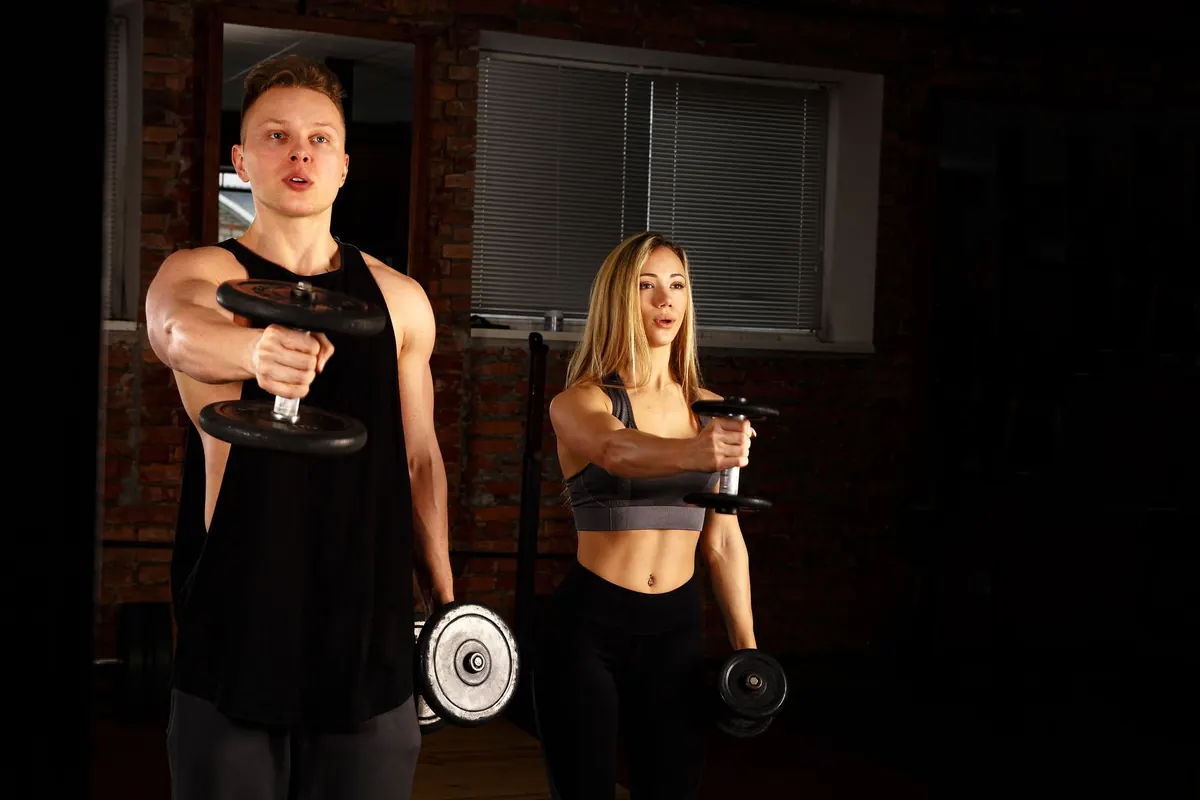
The first six weeks of strength training are not about how much you lift. They are about learning a handful of movements well enough that your body stops overthinking them, and then adding weight on a schedule you can actually repeat. Do that, and by week six you will walk into the gym knowing exactly what you are doing. That alone puts you ahead of most people who quit in January.
This plan assumes three sessions a week and access to dumbbells, a barbell, and a bench — at home or at a gym. Every movement has a dumbbell version if you are training in a garage. Expect 45 to 60 minutes per session, including warm-up.
What the Six Weeks Look Like
You train three days a week, never on back-to-back days, alternating two full-body workouts: A and B. A typical week is Monday A, Wednesday B, Friday A. The following week flips to B, A, B. Each muscle group gets roughly 72 hours of recovery, and every major movement pattern gets trained twice a week — which is the sweet spot for beginners.
Both sessions follow the same shape: a squat or hinge, a push, a pull, a single-leg or core movement, then a short finisher you can skip when time is tight.
Workout A
- Goblet squat or back squat: 3 sets of 8
- Bench press or push-up: 3 sets of 8
- One-arm dumbbell row: 3 sets of 10 per side
- Glute bridge or hip thrust: 3 sets of 10
- Plank: 3 sets of 30 seconds
Workout B
- Romanian deadlift: 3 sets of 8
- Overhead press: 3 sets of 8
- Lat pulldown or assisted pull-up: 3 sets of 10
- Split squat: 3 sets of 8 per side
- Dead bug: 3 sets of 8 per side
That is ten movements in total, but only six of them are "main" lifts — squat, hinge, bench, row, press, pulldown. Everything else supports them.
Sets, Reps, and How Hard to Push
Three sets of eight is a starting point, not a law. What matters is that the last two reps of each set feel genuinely hard while your form still looks clean. Coaches often describe this as leaving one or two reps in the tank. If you finish a set and could have cranked out five more, the weight is too light.
Rest two to three minutes between sets of the main lifts, and 60 to 90 seconds on the smaller ones. Beginners routinely rush this and then wonder why set three feels so much worse than set one. Bring a timer, or just watch the clock on your phone.
Always warm up first: five minutes of easy cardio, then two lighter sets of the first exercise before your working sets. A 20 kg bar for eight reps, then 30 kg for five, and you are ready.
Week by Week: How the Plan Progresses
- Weeks 1 and 2 — learn the movements. Keep the weight deliberately easy. Film one set of each lift from the side if you can; most form problems are obvious on video within seconds. Three sets of 8 on everything.
- Weeks 3 and 4 — start adding load. Once you complete all three sets at the top of the rep range with good form, add the smallest jump available: 2.5 to 5 kg for lower-body lifts, 1 to 2.5 kg for upper-body lifts. Stay at 3 sets of 8.
- Weeks 5 and 6 — build volume. Shift the main lifts to 4 sets of 6, keeping the accessory work at 3 sets of 8 to 10. The heavier, lower-rep work teaches your nervous system to produce more force, and the extra set adds a little more total work without wrecking your recovery.
If you stall on a lift for two sessions in a row, drop the weight by about 10 percent and build back up. That is not failure; it is how progression actually works.
Rest Days Are Part of the Program
You will have four non-training days each week, and at least two of them should be genuinely restful. Sleep is when your muscles actually repair, so aim for consistent bedtimes rather than chasing perfect numbers. A 20 to 30 minute walk on an off day helps with soreness and costs you nothing in recovery.
Light activity is fine — walking, easy cycling, a bit of stretching. What you want to avoid is adding three HIIT classes on top of this plan in week two. Cardio and strength training compete for recovery, and beginners recover more slowly than they expect.
Expect soreness for the first two weeks, especially in your legs after the first squat session. It fades. If something hurts sharply, in a joint, or on one side only, stop and get it looked at rather than pushing through.
Form Cues Worth Repeating
- Brace your midsection as if you are about to be poked in the stomach, then breathe out on the hard part of the lift.
- Keep your spine in one long line from hips to head. No rounding under load, no craning your neck.
- Control the lowering phase. Two seconds down, one second up beats dropping the weight every time.
- Use a full range of motion you can own. Half squats with heavy plates build half a squat.
- Grip the floor with your feet and keep your knees tracking over your toes.
If you can afford a few sessions with a qualified coach in the first month, spend them on the squat, hinge, and press. Good habits are much easier to build than to unlearn.
Make It Stick
Pick three fixed days and treat them like appointments. Write down your weights and reps each session — a notebook or a notes app is enough — because the whole plan depends on knowing what you did last time. Eat a decent amount of protein across the day, drink water, and get to bed. Skip the temptation to add exercises; the plan has enough.
Repeat the six weeks twice more, adding weight whenever you hit the top of the rep range, and you will have spent roughly four months doing something most people never manage: getting consistently, measurably stronger. If you have an existing injury, a heart condition, or you are pregnant, check with a doctor or a qualified trainer before starting a new program.
Photo: Aleksey Bystrov / Pexels